

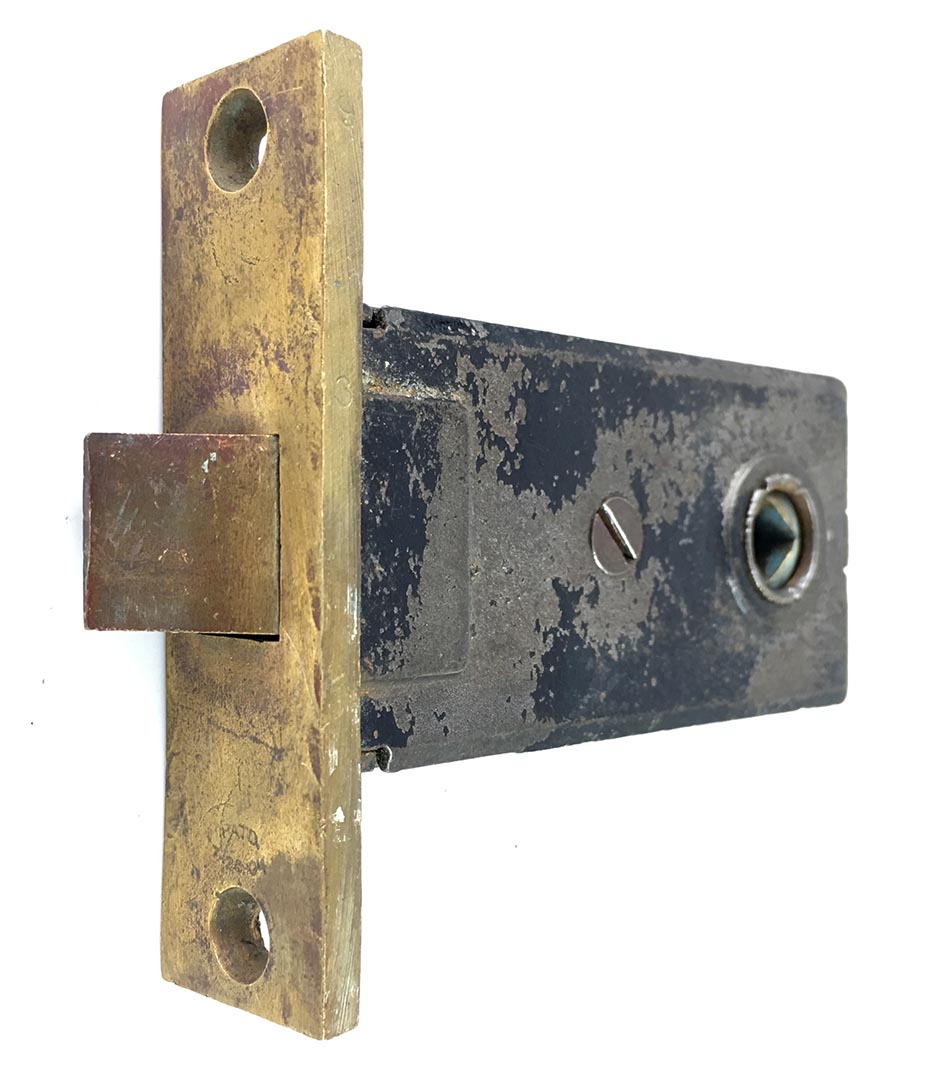



Antique Interior Door Passage Mortise Latch Lock - Bronze - Russell & Erwin Circa 1904
This is an antique interior passage mortise door latch with a solid bronze faceplate made by Russell & Erwin after 1904. This latch contains a patented oscillating lock hub, the function of this is detailed in the patent application which was granted in July of 1904: Be it known that I, HENRY G. VOIGHT, a citizen of the United States, residing at New Britain, in the county of Hartford, State of Connecticut, have invented certain new and useful Improvements in Compensating Hubs for Looks or Latches, of which the following is a full, clear, and exact description.
My invention relates to locks and latches, and particularly to the hub.
My object is to provide in a lock or latch case a hub which may oscillate after the usual manner and which may be rocked or swung out of a line diametrical to the lock-case to a sufiicient extent to prevent cramping or binding of the parts in use. I/Vhen an ordinary mortise-lock is applied to adoor, the lock-case is set into a mortise so arranged that the faceplate will lie flush with the edge of the door. Since some doors are provided with beveled edges, sometimes lock-cases are necessarily introduced in a plane oblique to the outer and inner surface thereof. In all cases, however, knob-spindles are passed through the door at right angles thereto, and consequently unless some loose play is provided when the knobspindle is turned it is liable to produce a binding or cramping of the parts, impairing the free action of the lock.
The purpose of my invention, broadly, is to provide in a simple manner compensating means to avoid any possible undue cramping or binding.
In the drawings, Figure 1 is a conventional representation of a latch and part of a latchcase, showing the hub in place. Fig. 2 is a plan view of the hub, showing adjacent parts in section. Fig. 3 is a side elevation of the hub detached. Fig. 4c is a rear elevation of the hub. Fig. 5 is a front elevation of one of the bearings for the hub. Fig. 6 is a perspective view thereof.
1 is a portion of a lock-case.
2 is a latch.
3 is a latch-slide.
4 I are roll-back arms cooperating with the latch-slide.
5 is a hub carrying said roll-backs, the ends of said hub being rounded or I semispherical.
6 is a spindle-passage extending transversely through the hub 5 from end to 'end.
6 is a spindle. The roll-backs 4 4 are pref erably formed integral with the hub 5.
The lock-case 1 is equipped with suitable hub supports or bearings 7 7 for the rounded ends of the hub 5. These bearings are annular and are cupped or rounded out, as at 7. The bearings or supports 7 7 are preferably formed separately from the lock-case, but may be formed integrally therewith. When formed separately, these bearings 7 have reduced shank portions 7 b arranged to fit freely within the apertures in thelock-case. This arrangement is best seen in Fig. 2, and the dotted lines will indicate that the spindle may cooperate with the hub even though the same is connected therewith in such a manner as to stand at an oblique angle to the lockcase. Were no compensating means provided, if the spindle stood at the angle indicated in dotted lines it is apparent that the rotation of the spindle would produce a wedging or camming action on the roll-back or associated parts (even if it were possible to swing said spindle as far out of line as shown) and the freedom of action of the lock would be greatly impaired;
The bearings 7 when made separately from the lock-case may have free rotative movement therein. Since the hub itself is rotatably independent of the bearings 7, the utmost freedom of action and ease of operation is insured whether the spindle passes through the lock-case at right angles or at an oblique angle.
By the term oscillate as used in the fol lowing claims I refer to the usual motion which is given to a lock-hub by the turning of the spindle to draw the latch. By the term rock or rocking I refer to that capacity of the hub to swingso that a spindle which is passed obliquely through the lock may cooperate with the hub in such manner as to be entirely free.
What I claim is 1. In a lock, an actuating-hub mounted to oscillate and to rock relatively to the lockcase, supports for the hub carried by said case and arranged to admit of said oscillating and rocking motion.
2. In a lock, an actuating-hub mounted to oscillate and to rock relatively to the lockcase, supports for the hub carried by said case and arranged to admit of said oscillating and rocking motion,and a spindle-passage through said hub transversely of the lock-case.
3. In a lock, an actuating-hub mounted to oscillate and to rock relatively to the lockcase, rotatable supports for the hub detachably carried by the lock-case and arranged to admit of oscillating and rocking motion of the hub relatively to said case as well as to said supports.
4. In a lock, a lock-case, an actuating-hub, supports on the inner side of said case to receive said hub and arranged to admit of an independent oscillating and rocking movement of said hub relatively to the lock-case and an arm projecting laterally of said hub.
5. In a look, a lock-case, an actuating-hub, supports on the inner side of said case to receive said hub and arranged to admit of an independent oscillating and rocking movement of said hub relatively to the lock-case and roll-back arms projecting laterally of said hub and a spindle-passage through said hub at right angles to the plane of the roll-back arm.
6. In a lock, an actuating-hub having rounded ends, a roll-back arm carried by said hub between said rounded ends and a spindle-passage through said hub from end to end.
7. In a lock, an actuating-hub, the ends of said hub being rounded, two roll-back arms carried by said hub and oppositely extending therefrom and arranged between said ends, and a spindle-passage extending through said hub from end to end.
8. In a look, a lock-case, an actuating-hub member arranged to be rotatably supported within said case, two independent cup-shaped hub-bearings carried by said case said hub having an oscillating and rocking movement relatively to said bearings.
9. In a lock, a latch, an actuating-hub adapted to be mounted to oscillate and. rock relatively to the lock-case, substantially as described.
Signed at New Britain, Connecticut, this 4th day of May, 1904.
HENRY Gr. VOIGHT.
Witnesses:
M. S. VVIARD, E. M. NORTH.
Mortise and rim locks have specific dimensions including backset, the measurement from the edge of the faceplate (the strip that shows when the mortise lock is installed in the door) to the center of the doorknob hub; and spacing, the measurement from the center of the doorknob hub to the center of the round part of the keyhole. The dimensions were not standardized in the 19th century so it is important to note the dimensions of your door prior to purchasing a mortise lock. Please click on Dimensions for size information.Click here to view our mortise lock search form which you can fill out and email or fax to us and we will search our inventory for a lock to suit your needs.
Do you have more locks than shown here?
We have a very large inventory of antique door hardware, including door locks and parts. We are happy to search our inventory for specific door locks you may need. Click here to view our mortise lock search form which you can fill out and email or fax to us and we will search our inventory for a lock to suit your needs.
Do you have lock parts?
Yes we have some lock parts, although these are available in limited quantities. You can see them here.
Do you offer lock repair services?
We do some basic lock repair work in-house only (we do not make house calls) and we do not offer same day service on lock repairs. If you can bring your lock in to leave with us we can try to fix it. Our service charge for lock repair is $35 if we are able to repair. If you are not in the Rochester, New York area please contact us first before mailing in a lock for repair.
How do I know what part I need for my broken lock? Or where the broken part goes in my lock?
Check out our Antique Mortise Lock Resources page to get some help with this, we are unfortunately not able to help with this as we are not locksmiths. You can see that resource page here.
Do you offer hardware polishing?
Yes we do, please email us a photo of your hardware for a price quote. or call us at 585-325-2329 for details. Please include the item number if you are looking at one of our items.
My lock is missing completely from my old door. How do I know what I need?
You have several options. First option: if the door is a style that is found elsewhere in your house you can start by removing the lock from an identical door in your house and try inserting it into the hole (also called the mortise) in the door you need the lock for to see if it fits. When houses were built, the builders purchased all the locks together so in most cases the locks found throughout a house will be the same brand and often the same size, although probably keyed differently. So if the doors throughout your house are the original doors, there is a good chance you will have the lock you need in another door. The exception to this is your front door, unless you have another exterior side or back door which also has an exterior mortise lock. These exterior door locks are usually larger and have additional features over smaller interior mortise locks.
Second option: If option #1 does not apply, for example your door is a replacement that does not match any other doors in your house, or you tried all the other locks in the house and none of them work, you will need to find a lock using the dimensions of the hole (mortise) in the door. We are happy to search our inventory for specific door locks you may need once you provide us with the exact dimensions using our Mortise Lock Search Form. Click here to view our mortise lock search form which you can fill out and email or fax to us at 585-325-3613 and we will search our inventory for a lock to suit your needs. You can email us here.
How do I get the lock out of my door?
The lock itself is held into your door by two screws that are found on the top and bottom of the faceplate which is on the edge of your door. However, there are several other parts that need to be removed before the lock can be pulled out of the hole (mortise).
Here are the steps to remove your INTERIOR door lock:
- First you need to remove the doorknobs. Each knob is mounted onto either end of a rod called a doorknob spindle. The knobs are held onto the spindle using screws or pins. The screws, called set screws are the most common method of securing a doorknob onto a spindle. Look on the neck or shank of the doorknob for the head of the screw and just unscrew it. You only need to unscrew one side, and pull the other knob out of the door and it should slide out with the spindle attached. Be very careful not to lose the set screw some of these are obscure sizes and thread counts and extremely difficult to replace if lost. For that reason we recommend being very gently when unscrewing these, taking care not to damage the fragile threads. Screw the screw right back into the spindle for safekeeping while you are working on the lock.
- If your doorknobs came out easily using the first step you may be ready to pull the lock out of the door by unscrewing those two screws on the faceplate of the lock on the edge of the door. Again, preserve those screws so you dont lose them. Put a screwdriver into the hole where the doorknob spindle was installed and gently push the lock out of the hole in the edge of the door. It should pop out.
- Not working? You may have a privacy lock which is used on bathroom doors and has a thumbturn which locks the door from the inside. If that is the case, there should be a couple of screws on the faceplate of that thumbturn which you can remove (put them someplace safe with the thumbturn) and pull the thumbturn out. Once it has been removed, the lock should slide out of the door easily.
- Still not coming out? If the edge of your door is painted, including the lock faceplate, you can take a utility knife and score the paint around the edge of the faceplate on the edge of the door. Once you have broken that paint seal, you should be able to slide the lock out. Still stuck? If your door has round rosettes that are mounted behind the doorknobs, sometimes the small screws that mount these to the door surface are too long so they penetrate into the hole (mortise) that the lock is mounted into and they will prevent the lock from coming out. So you may need to remove those to get the lock out.
Here are the steps to remove your EXTERIOR door lock:
- First, you need to remove the doorknobs. Each knob is mounted onto either end of a rod called a doorknob spindle. The knobs are held onto the spindle using screws or pins. The screws, called set screws are the most common method of securing a doorknob onto a spindle. Look on the neck or shank of the doorknob for the head of the screw and just unscrew it. You may only need to unscrew one side, and pull the other knob out of the door and it should slide out with the spindle attached. Be very careful not to lose the set screw some of these are obscure sizes and thread counts and extremely difficult to replace if lost. For that reason we recommend being very gently when unscrewing these, taking care not to damage the fragile threads. Screw the screw right back into the spindle for safekeeping while you are working on the lock. If your knobs are different sizes, you will probably have to remove both using this same method. If your exterior door has a handle and thumb press on the outside instead of a knobs, remove this by removing any screws holding it into place.
- Next, remove the deadbolt cylinder. There is a single machine screw that is found on the faceplate on the edge of your lock that is holding your cylinder in place, unscrew this first it is reverse-threaded from a regular wood screw so turn it the clockwise to unscrew it. Then unscrew the ring (collar) around the cylinder on the outside of the door if there is one, and unscrew the cylinder itself and pull it out of the door.
- Next, remove the screws holding the thumbturn on the inside of the door in place and pull that out. If there is a doorplate with an attached thumbturn on the inside of the door, remove the screws that attach that to the door and remove that piece.
- Once all the surface mounted hardware has been removed from your door, you should be able to insert a screwdriver into the doorknob hole, and press the lock out of the hole (mortise).


